INTRODUCTION
Needs an overview here that explains exactly what the project is… I wonder if sharing some of the details of that history here would be useful.
Meet the team!
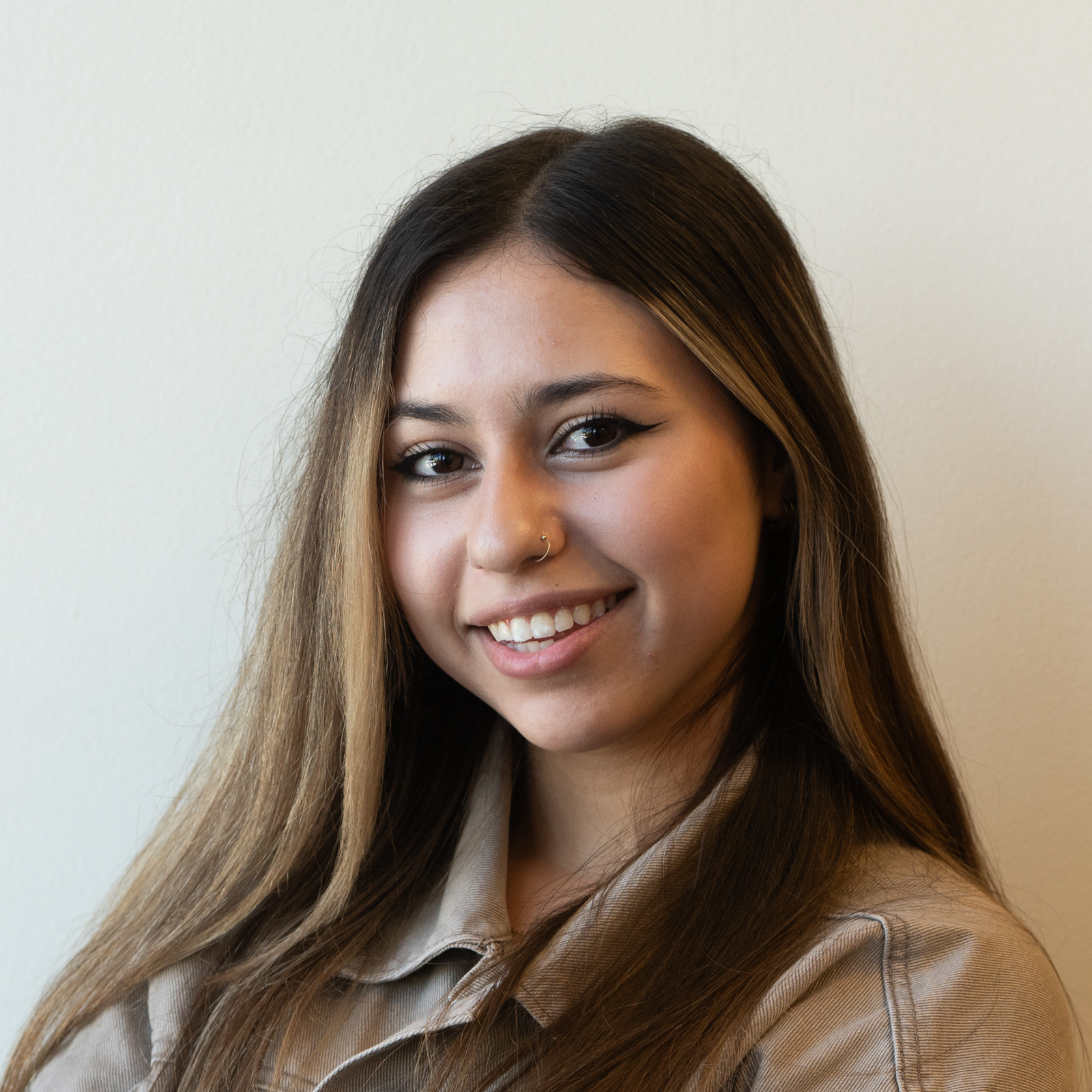
Alejandra Beltran, P
Political Science Major with a Focus on Pre-Law and Spanish
Author Bio
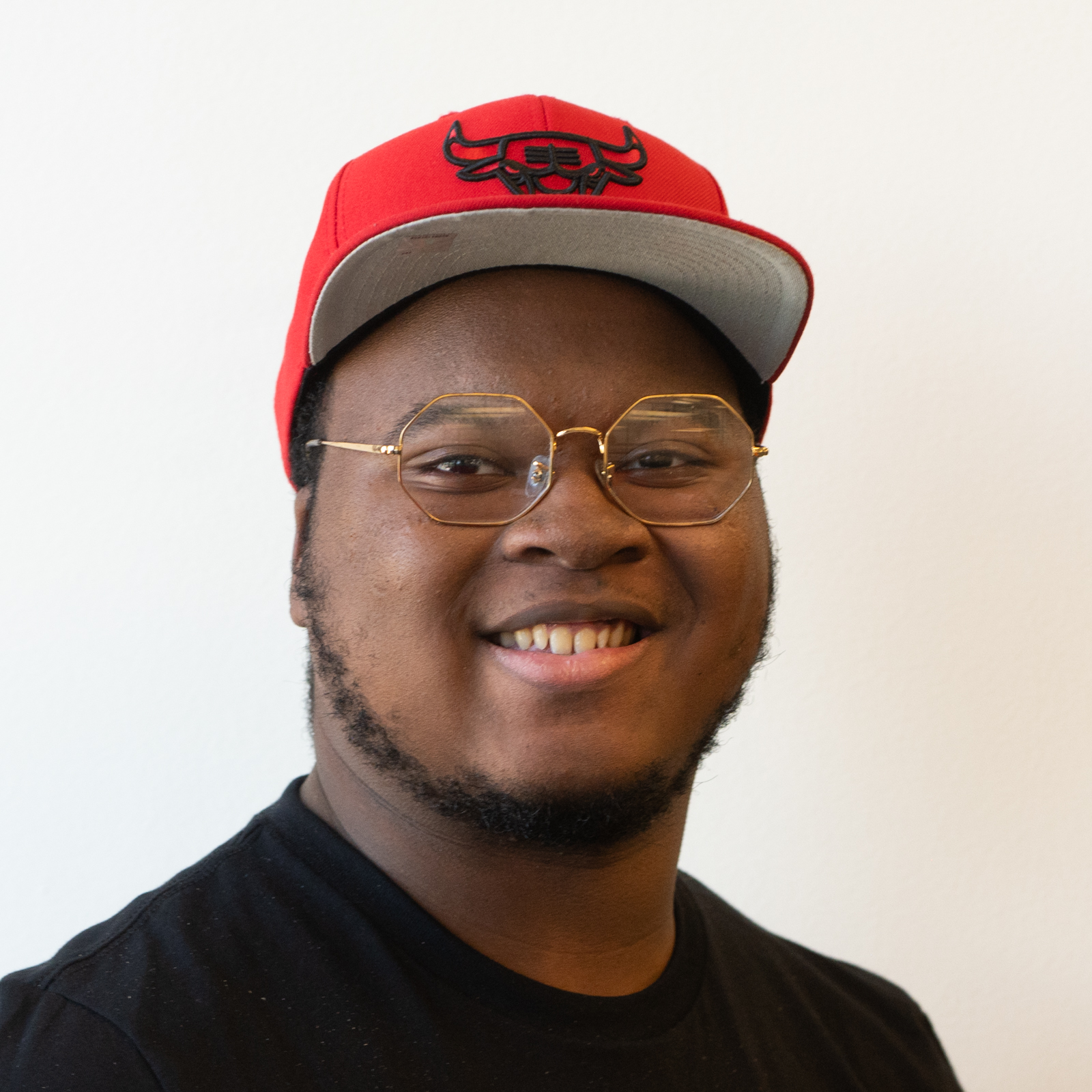
Zachary Tobias
Applied Communications Major with a Focus in Public Relations
Author Bio
Faculty Mentor
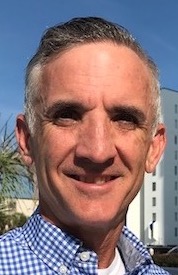
Dr. Bryan Jack
Department of History
Community Partner: The Missouri Botanical Garden
The 2027 class of CODES Scholars partnered with the Missouri Botanical Garden through the theme of reparative
justice, an approach that centers healing, accountability, and the repair of past harms. Drawing on MOBOT’s
archives and Henry Shaw’s papers, this project explores how the Garden’s history can be shared with greater
honesty and care. Working alongside Michelle Bonner, Robbie Hart, and Andrew Colligan, CODES Scholars
examine the institution’s history of enslavement, the erasure of Black and Brown communities connected to
Shaw Nature Reserve, and the Indigenous knowledge and cultural context reflected in Herbarium specimens.
Through this work, the project helps MOBOT tell these stories with intentionality and sensitivity while creating
more meaningful ways for visitors to engage with them.
PROJECT SUMMARY
We wanted to promote understanding of the history of enslavement connected to the Missouri Botanical Garden through an interactive, accessible, and reflective public history experience. By using stations, shortened documents, and QR access to full archival materials, the project aims to help participants engage more directly with the stories, records, and silences that surround this history.
Our vision was to create an experience that welcomes a wide audience while encouraging a deeper relationship to the Garden, its archives, and the histories that have too often remained in the background. The project imagines a space where visitors not only admire the Garden as a site of beauty but also recognize it as a place shaped by human labor, inequality, and historical erasure. In that sense, the interactive learning pathway is meant to invite acknowledgment, reflection, and a more honest relationship to institutional memory.
The final product takes the form of an interactive learning pathway made up of a series of stations that guide visitors through the history of enslavement connected to Henry Shaw and the Missouri Botanical Garden. Each station is designed to feel clear, consistent, and inviting so that participants can immediately understand the focus of the material without being overwhelmed by too much information at once. The experience should feel educational and reflective, while still remaining accessible to visitors who may be encountering this history for the first time.
Our “Why”
One of the strongest parts of this project is the reason behind it. From the beginning, the work required us to maintain a sense of responsibility. It was exciting to approach the project with the idea that we could help bring forward stories that had once been overlooked or silenced, but that excitement also came with the realization that this history could not be handled lightly. The more we worked with the documents, the clearer it became that this project needed to do more than present information. It needed to create an experience that encouraged people to stop, read, and think.
Our resulting project is rooted in the desire to make hidden histories visible in a way that feels engaging rather than distant. While a traditional display can present historical documents, our interactive format gives visitors a reason to move with intention, follow a guided route, and connect each station to a broader story. That matters because the history of enslavement should not be reduced to a few isolated facts or documents. It should be encountered as something that shaped individual lives, institutions, and the meaning of place itself.
The project also reflects a great deal of care in how that history is presented. Building it required working through logistical challenges, a large volume of documents, and moments when the historical connections were not immediately clear. Rather than weakening the project, those challenges strengthened it. They pushed us to think more carefully about what we chose to show, how we chose to show it, and what kind of response we wanted to create in the audience. As a result, the final experience is designed not only to share information, but also to encourage visitors to pause, reflect, and engage with this history in a more meaningful way.
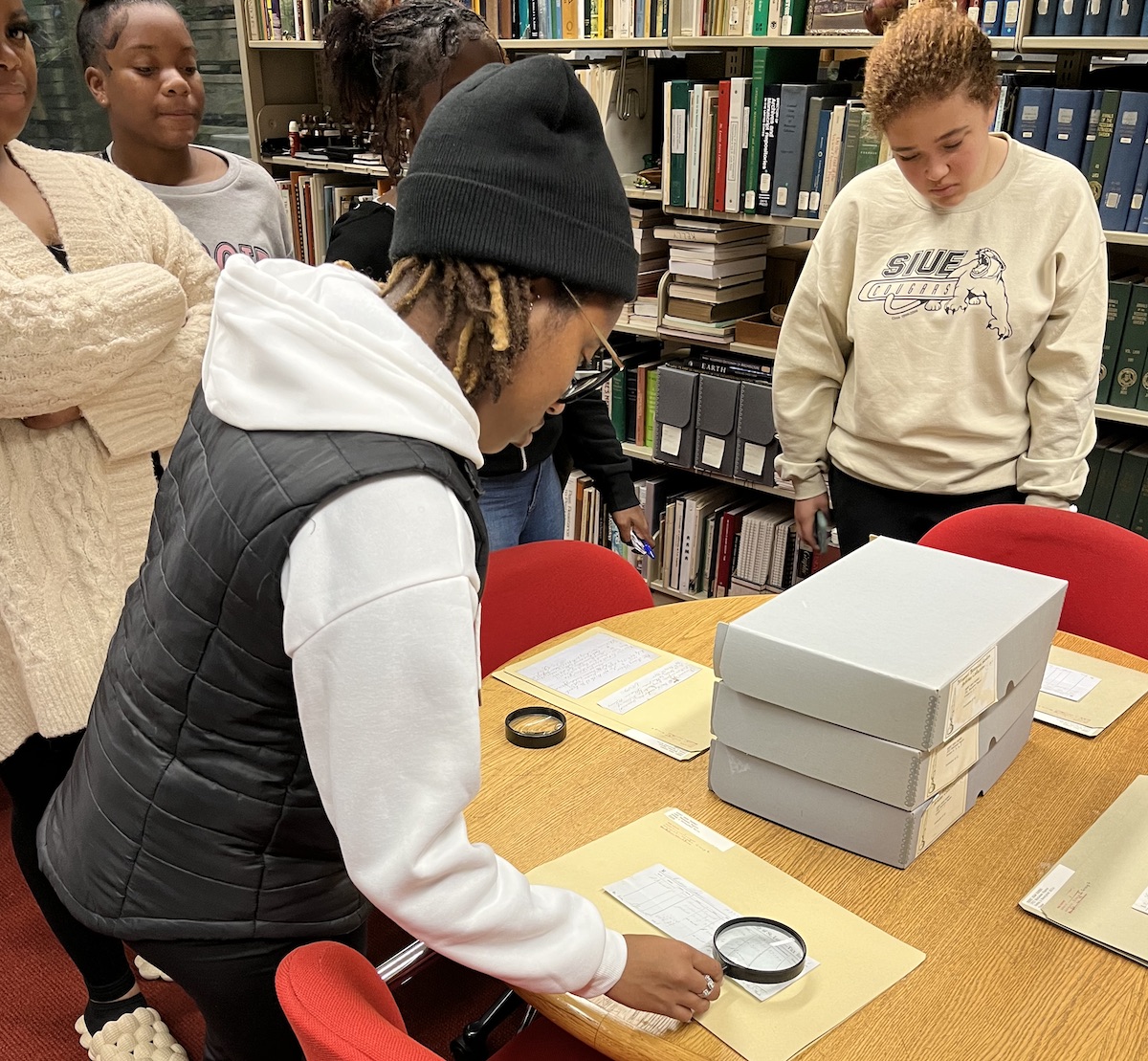
Archival Examination at Documents at MOBOT’s Research Library
Back from left: Bryana Nichelson and Britney Lewis, Kadynce Sanders
Foreground: TaKara Gilbert
Reparative Justice
This project engages in the work of reparative justice because it is grounded in truth-telling, access, and public engagement. Reparative justice is not only about recognizing that harm happened. It is also about asking how institutions can acknowledge that harm in ways that are meaningful, visible, and socially responsible. A project like this contributes to that work by taking archival materials that might otherwise remain distant and making them part of a shared public encounter.
The interactive learning pathway format is especially appropriate because it asks participants to do more than observe. They must move through the space, read, interpret, and reflect. That shifts from passive viewing to active engagement matters and has a cognitive impact. It encourages people to understand the Garden not as a neutral backdrop, but as a place tied to histories of enslavement, power, and exclusion. If we center those histories, the project resists the tendency to let beauty erase violence or to let institutions tell only the most comfortable version of their past.
The project also supports reparative justice by increasing access. Each station provides a short, readable entry point into the historical material, while the QR code gives participants access to the fuller document. That structure respects different levels of engagement. Some visitors may pause for a brief encounter, while others may want to explore the archives more deeply. Either way, the project creates a path toward historical visibility and reflection, which is one meaningful step in reparative work.
Research Questions
Across two years of research, we focused on two guiding questions to investigate our “wicked” problem:
- How can the new generation become advocates for their community?
- How can we shed light on areas like Cahokia Heights that face water inequity?
- How can we implement education for youth, influencing a new generation to become aware of water conservation issues?
These questions shaped our work on about water equity and youth education.
RESEARCH METHODS
We interviewed local educators and organizations, surveyed nearly 200 educators, and learned from SIUE’s STEM Center faculty about lesson plan development. These methods helped us understand our “wicked” problem and barriers educators face, and guided our decision to focus on after-school programming, which has fewer restrictions.
During our second semester in CODES, we immersed ourselves in research, gathering data, and overall familiarizing ourselves with water inequity. We created a survey, “Teachers’ Perspectives on Water Conservation Education,” which we sent to educators to get a better understanding of whether pedagogical practices were taught in the classroom to address water equity issues.
We received 196 responses, mostly from teachers of grades 6–8.
Educators agreed that hands-on labs work best, yet most do not teach water conservation; the main reasons why they do not center on a lack of awareness, lack of funding, and strict curriculum requirements. Thus, we learned that either teachers lack material and/or financial resources or knowledge to implement hands-on activities to educate students on water conservation.
Our results were eye-opening and arguably the most important takeaway. Thus, we presented our findings at SIU System Day at the Illinois State Capitol and will follow up in March 2026.
Click here to learn more about our survey results and findings.
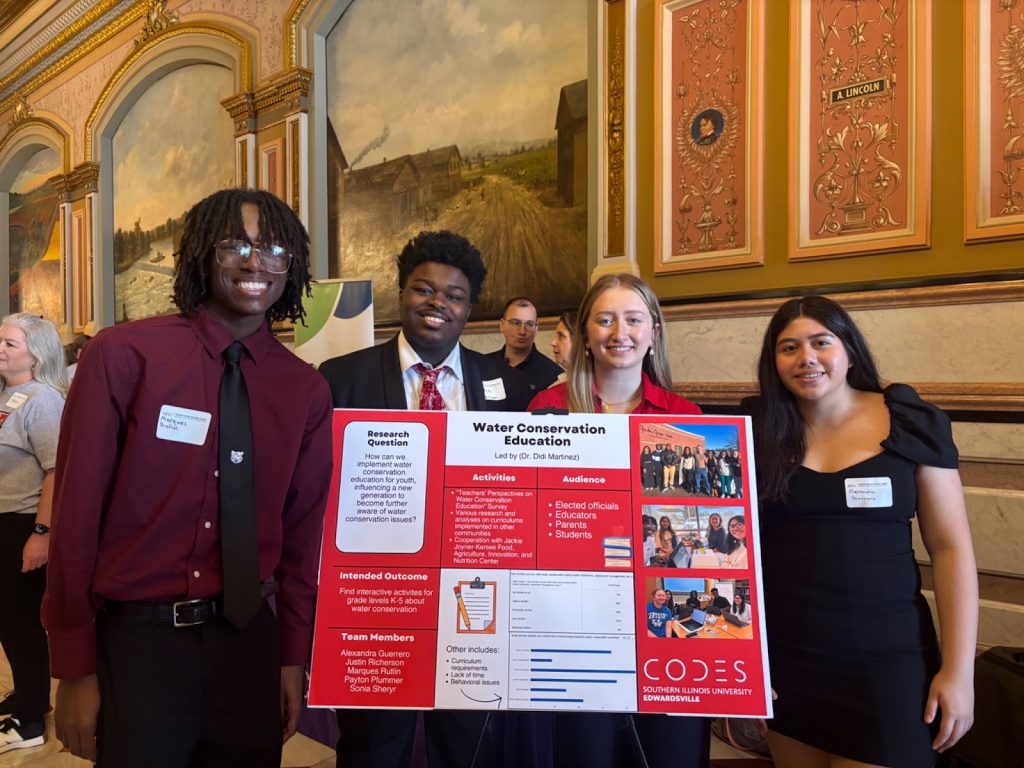
SIU System Day at the Illinois State Capitol
Marques Rutlin, Justin Richerson, Payton Plummer, Alexandra Guerrero
FINDINGS + THEMES
In addition to our surveys, we also conducted interviews with Danforth’s Zachary Stafford and Dr. Andrea Dexheimer, research assistant professor in the SIUE Center for STEM Research, Education, and Outreach.
Zach Stafford + JJK Academy
Our interview with Stafford, who works with after-school children at the JJK Academy, and who discussed how the kids at the academy learn and what changes are feasible to their after-school program, revealed several themes:
Technology as a learning tool: Stafford expressed interest in using drones and imaging to help kids visualize water issues.
“Drones! That’s what I’m trying to get right now. We have a good drone program, it’s probably one of my favorite ones. And I’ve been trying, begging and begging for a thermal imaging drone. And just no luck, no funding… I think stuff like that, that’s easy for kids to understand, where they can automatically pull up a chart, I think is great.
Zach Stafford
Hands-on, science-forward activities: He emphasized that science often takes a backseat to math and reading, although “water conservation hits a lot, and science [but] they’re not the focus kind of test scores.” Thus, making after-school programs a valuable space for hands-on learning will remediate the gap in state science education requirements.
Connecting learning to home life: Stafford wants students to take what they learn and apply it in their homes and communities, hoping they can make a lasing difference in their community.
Click here to read the full transcription of Stafford’s interview.
Dr. Andrea Dexheimer + SIUE’s Stem Center
One of our last steps in our research semester was visiting SIUE’s STEM Center. Dr. Dexheimer, who shared with us all the things that go into finding and creating lesson plans (e.g., Bloom’s Taxonomy). This was especially helpful for both those who constructed water fair activities as well as plans for the water fair toolkit.
See below to browse and visit the various products we created to solve our “wicked” problem and empower change through water education at JJK Academy!
PROJECT DELIVERABLES
To create consistency, every station follows the same basic structure: a title, a short document excerpt or plain-language summary, a QR code linking to the fuller archival source or supporting material, and a question or prompt that asks participants to reflect on what the document reveals. This repeated format helps visitors know what to expect as they move from one station to the next, while still allowing each document to tell a distinct part of the larger story. The layout is intentionally designed to balance accessibility with depth. The shortened text gives visitors enough context to understand the significance of the document while standing at the station, without requiring them to read a full archival record on the spot. At the same time, the QR code offers a deeper level of engagement for participants who want to explore the original document, read a transcript, or learn more about the historical context. In this way, the pathway welcomes both brief interaction and more sustained learning.
CONCLUSION
All in all, we six sophomores are feeling bittersweet about wrapping up our final CODES project. We have all played an important role in the research and implementation, but we couldn’t do it without our research team professor, Dr. Adriana Martinez, SIUE Environmental Sciences professor and department chair. She has been an incredible mentor, guiding us every step of the way. We are beyond grateful to have had her support, guidance, and willingness to collaborate with us—starting when we were six brand‑new freshmen away from home for the first time.
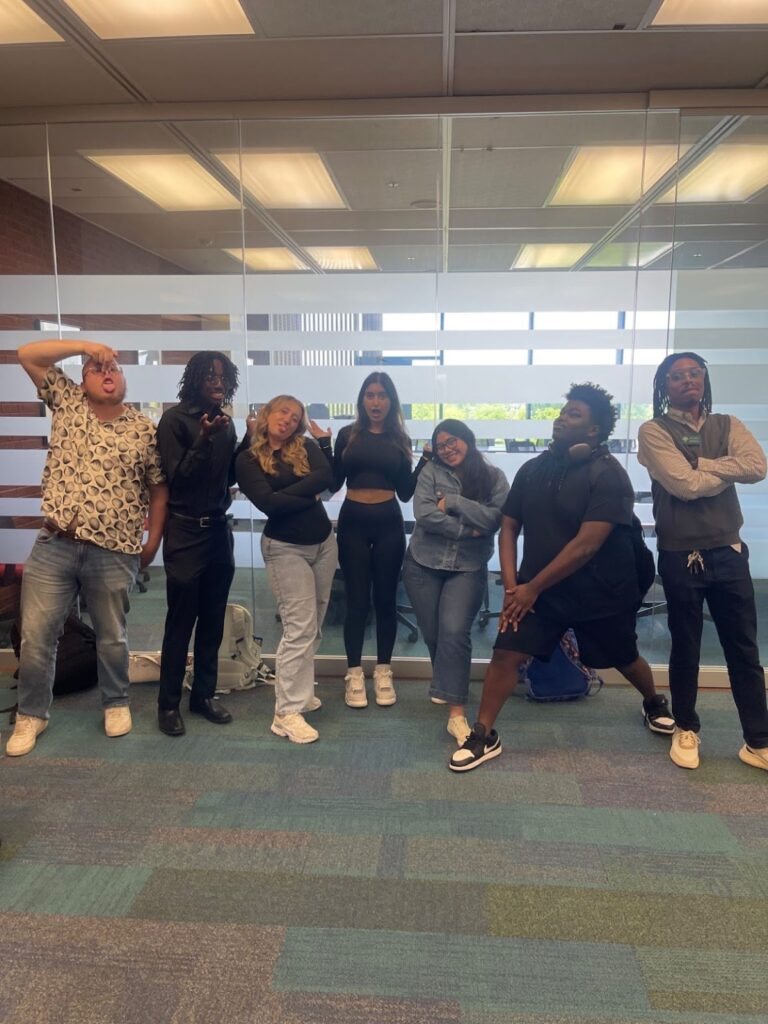
Our next step for this water education is to distribute our work to other communities. We are still working with Kurly Taylor, who is interested in expanding this education further. We hope to reach additional communities experiencing the same wicked problem we are.
Appendix: Supplementary Materials
Bloom’s Taxonomy
Information on CODES Water Fair
Survey Results: Teachers’ Perspectives on Water Conservation
Zach Stafford Interview Transcription
Water Fair Toolkit (In progress)
Works Cited
Community-Oriented Digital Engagement Scholars (CODES)
Jackie Joyner-Kersee Academy (JJK Academy)
Jackie Joyner-Kersee Food, Agriculture, Nutrition, and Innovation Center (JJK FAN)
National Great Rivers Research and Education Center
Southern Illinois University Edwardsville (SIUE)
This Black Town Has E. Coli in Its Drinking Water, but Feds Just Cut Support
Experts: U.S. water infrastructure in trouble – CNN.com
Water supplies in crisis – BBC News