
The Missouri Botanical Garden is a place of beauty, learning, and growth, with a history deeply connected to St. Louis. During the nineteenth century, enslavement was woven into the social and economic fabric of St. Louis. Archival records reveal connections between Shaw and enslaved individuals, yet many of their names, experiences, and contributions remain incomplete or absent from the historical record. Through archival research, reflection, and exploration, we invite you to consider whose stories are remembered, whose stories are missing, and how confronting the past can help us build a more honest and inclusive future.
·INTRODUCTION·
“History of Our Soil: A Journey Through Time” is an interactive exhibition thought to be located in Henry Shaw’s Tower Grove House at the Missouri Botanical Garden. It explores the history of enslaved individuals connected to Henry Shaw who lived and worked on the land that would later become one of St. Louis’s most recognized institutions.
Grounded in reparative justice, the project draws from the Henry Shaw Papers, Garden records, and archival research to bring forward stories that have often been overlooked. Through this experience, visitors are invited to consider how the Garden’s beauty and history developed alongside systems of forced labor and displacement.
Meet the Team!


Alejandra Beltrán
Political Science Major with a Focus on Pre-Law and Spanish
Zachary Tobias
Applied Communications Major with a Focus in Public Relations
Faculty Mentor
Community Partner

Dr. Bryan Jack
Professor and Director of SIUE’s Universities Studying Slavery Initiative
Missouri Botanical Garden
2027 CODES Community Partner
Community Partner: The Missouri Botanical Garden
The CODES Scholars Class of 2027 partners with the Missouri Botanical Garden through a project centered on reparative justice.
Drawing on MOBOT’s archives and the Henry Shaw Papers, the project explores how the Garden’s history can be shared with greater honesty and care. In collaboration with institutional partners, CODES Scholars examine histories of enslavement connected to the institution, the limited representation of Black and Brown communities connected to Shaw Nature Reserve, and the Indigenous knowledge and cultural context reflected in Herbarium specimens.
Through this work, the project supports MOBOT in sharing these stories with intentionality and sensitivity while creating more meaningful ways for visitors to engage with them.
·PROJECT SUMMARY·
Our Vision
“History of Our Soil: A Journey Through Time“ seeks to create an accessible public-history experience that helps visitors better understand the history of enslavement connected to the Missouri Botanical Garden. Through archival materials and guided interpretation, the project encourages a deeper relationship with the Garden, its history, and the stories that have not always been fully included in institutional memory.
Our Why
The labor of enslaved African Americans was connected to Henry Shaw’s properties, including the land and buildings that later became part of the Missouri Botanical Garden. Although this labor contributed to the maintenance and development of these spaces, the experiences and identities of enslaved individuals have often received limited attention in historical narratives.
This history is important because St. Louis was shaped by enslavement, Indigenous displacement, and unequal systems of power. By bringing these connections forward, the project asks visitors to consider whose stories have been preserved, whose stories have been overlooked, and why those absences matter.
The Hurdles We Overcame
Developing this project required working through a large volume of archival material, incomplete records, and historical connections that were not always easy to trace. In some cases, documents provided only limited information about the people connected to Shaw’s properties.
These gaps became an important part of the research process. They showed how historical records can preserve certain perspectives while leaving others incomplete. The project team had to carefully consider what information could be included, how it could be presented clearly, and how to avoid oversimplifying difficult histories.
Honoring Reparative Justice
This project is guided by reparative justice through its focus on truth-telling, accountability, and public access. Reparative justice encourages institutions to recognize past harms and to consider how they can respond in responsible and meaningful ways.
By placing archival materials in a public setting, “History of Our Soil: A Journey Through Time“ creates an opportunity for visitors to engage with histories that may otherwise remain distant or unseen. The project does not treat the Garden as separate from its past, but instead encourages a fuller understanding of the people, systems, and histories connected to it.
·OUR RESEARCH·
Research Questions:
Across two years of research, we focused on the following guiding questions to plan our exhibit:
- Where can we locate reliable information about Shaw, enslavement, and the individuals connected to his estate?
- Which archives, institutions, databases, and collections will serve as the primary sources for gathering these materials?
- Which primary and secondary documents are most essential to understanding Shaw’s relationship to enslavement and the lives of the enslaved individuals connected to his estate?
- To what extent are these materials currently accessible to the public, and what barriers are limiting access?
- How can this history be presented in a way that honors enslaved individuals, accurately addresses Shaw’s role in enslavement, and acknowledges his broader significance to the history of St. Louis?
- What communication methods would most effectively convey this information to Garden patrons in an accessible, thoughtful, and respectful manner?
- How can visuals, movement through physical space, and digital access points strengthen visitor engagement with this history?
Research Methods:
Our project used archival research in collaboration with staff members at the Missouri Botanical Garden (MOBOT). Working with Andrew Colligan, we examined primary-source materials connected to Henry Shaw and the history of the Garden.
We reviewed handwritten documents, financial records such as bills of sale, property records, and census materials from MOBOT’s archival collection. Our research focused not only on what we were able to find in the archives, but also on what was missing or did not fully fit into the larger story.
Many of the records provided limited information about workers, enslaved individuals, and Indigenous communities connected to these spaces. These gaps became an important part of our research because they show how people and experiences can be erased or overlooked in historical records. By paying attention to both the evidence that exists and the information that is missing, we aimed to build a fuller and more honest understanding of the history connected to Henry Shaw and the Garden.
·FINDINGS·
Locating the Evidence:
Core Collections:
Essential Documents:
Reliable information about Henry Shaw, enslavement, and people connected to his properties can be found primarily in the Missouri Botanical Garden Archives, including the Henry Shaw Papers and institutional records. These materials can be strengthened through census schedules, property records, newspapers, and local or state historical collections that provide broader context about nineteenth-century St. Louis.
The most important collection for this project is MOBOT’s Henry Shaw Papers, along with Garden records and digitized historical materials. These sources preserve records connected to Shaw’s personal, financial, and property-related activities, making them essential for tracing connections between Shaw, his estate, and enslavement.
The most valuable primary sources include bills of sale, financial receipts, correspondence, property records, census schedules, and newspaper advertisements. Records such as Shaw’s reward advertisement for Sarah and her son, documents connected to Esther, and receipts concerning James and Sally provide direct evidence of his relationship to people he enslaved.
Access and Barriers:
Historical Interpretation:
Visitor Communication:
Access to this history is uneven. Some materials have been digitized and made available through MOBOT’s online historical collections, but many records still require archival research, staff guidance, or experience reading nineteenth-century handwriting and terminology. Another major barrier is the archive itself: records often preserve financial transactions or property details while providing limited information about the lives, families, and experiences of enslaved people. These absences are not simply missing details; they are part of what the project asks visitors to notice.
This history should be presented with accuracy, care, and respect for the people whose lives appear in the records. The project centers available names, documents, and individual stories while clearly recognizing the limits of the archive.
Rather than separating Henry Shaw’s contributions to St. Louis from his involvement in enslavement, the project presents both as part of a fuller historical account. This approach allows visitors to understand the Garden’s legacy with greater honesty and context.
The most effective way to share this information is through short, clear language supported by selected archival excerpts, visual materials, and opportunities for reflection. Visitors should be given enough context to understand each record without being overwhelmed by dense historical information.
The project uses a respectful tone that encourages learning rather than judgment. It invites visitors to consider what the documents reveal, what they leave out, and why both matter.
Engagement Through Space and Digital Access:
Visuals, movement, and digital access help turn archival research into an active learning experience. As visitors move through the stations, they can connect individual documents to a larger story about land, labor, memory, and institutional history. QR codes provide access to full archival materials for visitors who want to explore further, while shorter summaries make the project accessible to those encountering this history for the first time. Together, the physical pathway and digital resources create space for both learning and reflection.
Archival Documents Examined:
(List each of the documents we gathered. Include description of the document, why the specific doc was important and how it contributed to the exhibit, and the link to the online version)
·OUR PRODUCT·
The Experience
    "History of Our Soil: A Journey Through Time" is a self-guided interactive learning pathway located in and around Henry Shaw’s Tower Grove House at the Missouri Botanical Garden. The pathway uses archival research, visual interpretation, and physical movement through the space to introduce visitors to histories of enslavement connected to Henry Shaw, his properties, and the development of the Garden.
    The experience is designed as a sequence of short, connected encounters. Rather than presenting visitors with one large display, it breaks the history into focused moments that are easier to understand, explore, and reflect on.
Station Components
    Each station is designed as a clear and complete learning moment. Every stop includes:
A focused title:
Introduces the person, document, place, or question at the center of the station.
A short historical narrative:
Provides essential context in accessible language without overwhelming the visitor.
An archival visual:
Features a document excerpt, historical image, map, or related visual material that connects visitors directly to the historical record.
A reflection prompt:
Encourages visitors to pause and consider what the record reveals, what may be missing, and why the history matters.
A QR code:
Connects visitors to full documents, transcriptions, source information, and additional historical context.
Visitor Journey
    The pathway begins with an introductory station in Tower Grove House that provides context for the project and explains how visitors can move through the experience.
    The following stations guide visitors through individual records and broader themes, including enslavement, labor, land, memory, and historical absence. Each station contributes to a larger narrative, allowing visitors to connect separate documents and stories over the course of the pathway.
    The experience concludes with a final reflection station in Tower Grove House. This closing point invites visitors to consider how the history they encountered changes their understanding of the Garden and its place in St. Louis history.
Digital Access and Accessibility
    The learning pathway combines concise on-site interpretation with optional digital exploration. Visitors can engage with the essential information at each station or use the QR codes to access full archival materials and continue learning at their own pace.
    The stations are designed with readable text, clear visual organization, and consistent placement of information. This format supports visitors with different levels of historical knowledge and allows the experience to remain accessible without simplifying the complexity of the history.
Completion and Takeaway
    At the end of the pathway, visitors may receive a certificate of completion or similar takeaway that recognizes their participation in the full experience.
This final component reinforces "History of Our Soil: A Journey Through Time" as more than a display. It is a guided learning experience that connects visitors to archival evidence, encourages thoughtful reflection, and creates a more complete understanding of the Garden’s history.
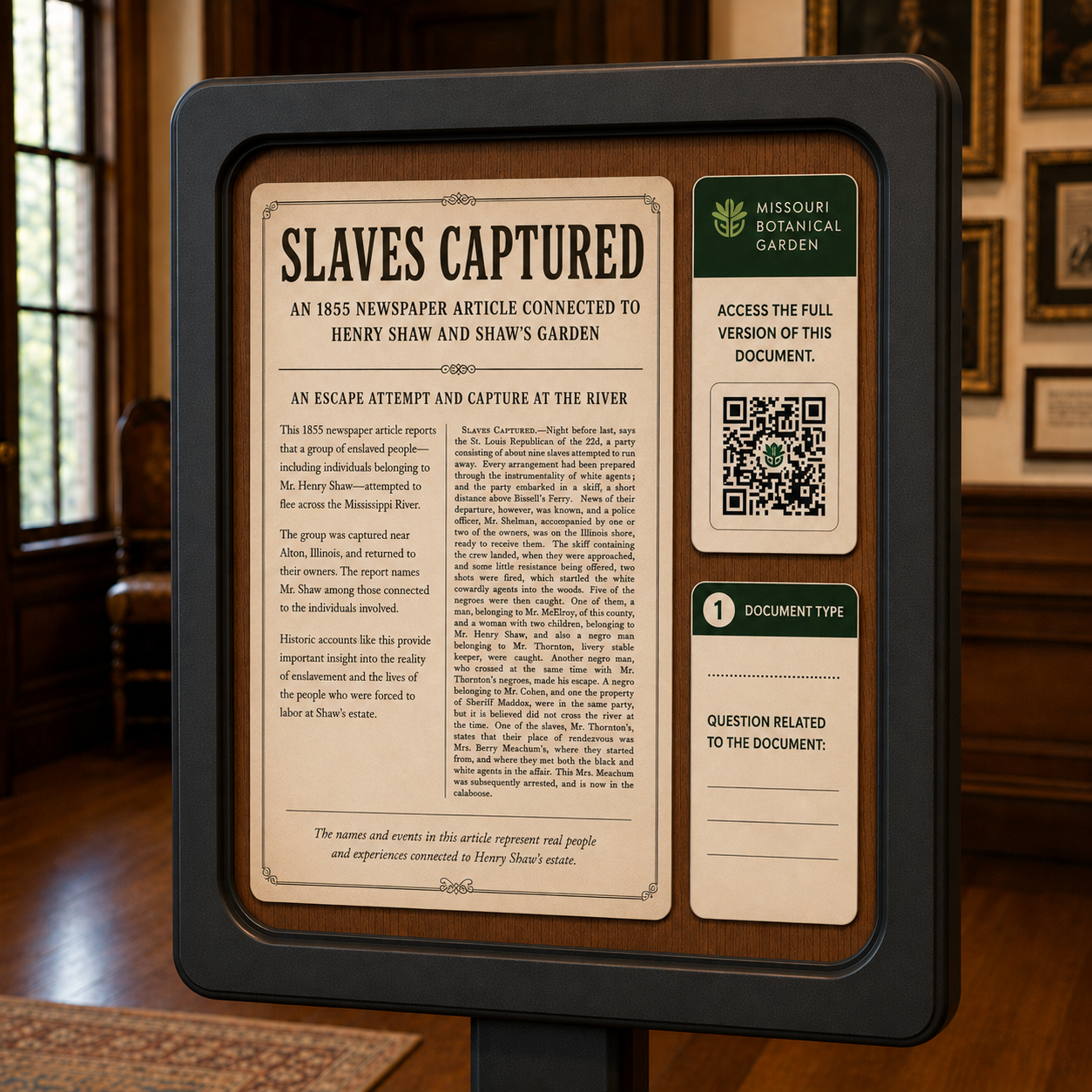
Proposed indoor station for the "History of Our Soil: A Journey Through Time"
·CONCLUSION·
Working on “History of Our Soil: A Journey Through Time” showed us that difficult histories cannot be approached with simple answers. As we researched, we learned that archives can reveal important connections while also leaving many questions unanswered. This process taught us the importance of patience, care, and honesty when working with stories that have too often been overlooked.
The lessons we learned through this project shaped more than our understanding of the Garden’s history. They also shaped our journey as CODES Scholars by reminding us that meaningful community work requires listening, collaboration, and a willingness to confront the past with humility. We hope this pathway encourages visitors to look more closely at the Garden, reflect on the stories connected to it, and carry that curiosity beyond the experience.


