Faculty Mentors
Dr. Adriana Martinez and Dr. Jacqueline Shea
Community Partners
Heartlands Conservancy, Jackie Joyner Kersee Food Agriculture and Nutrition Innovation Center (JJK FAN), and Cahokia Public Library District
CODE Scholars
Ayiana Baynes, Lindell Blount, Sa’Dae Cooper, Jasmine Davis, Jaiden DeBoe, Tamiria Dixon, Ava Gillery, Alexandra Guerrero, Eriel Johnson, Nadia Harris, Keith Hawkins, Julez Hill, Lyric Howard, Samuel Lee, Laylah Leech, Aiden Martinez, Zuleyri Medina-Campos, Isaiah Otey, Jada Parker, Payton Plummer, Justin Richerson, Margues Rutlin, Sonia Sherer, Nikyra Wheaton
Project Partners and Topic Development
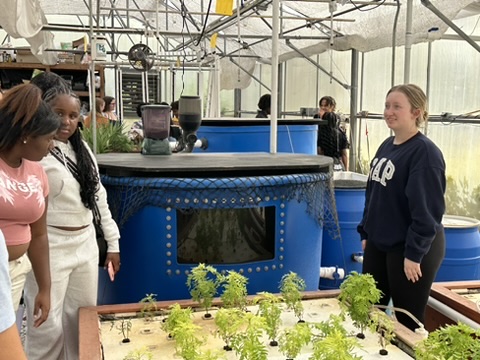
The Fall 2024 CODES cohort focused on thinking through and helping to solve issues of water inequity and injustice in Madison and St. Clair Counties. To do this work, we partnered with two local community organizations: The Jackie Joyner Kersee Food, Agriculture, Nutrition Innovation Center (JJK FAN) and Heartlands Conservancy. JJK FAN works with youth in East St. Louis to transform the community through urban agriculture, food system resiliency and career readiness.
Heartlands Conservancy is the region’s largest conservation organization with a commitment to “balance conservation strategies with economic sustainability and human well-being.” Both of these organizations do work in the Southern American Bottom, a collection of watersheds that together form the floodplain of the Mississippi River. These watersheds are pivotal to the health of several under-resourced towns including East St. Louis, Alorton, Washington Park, Fairmont City, Centreville, Cakokia Heights, and Brooklyn, IL. Our goal in working with these organizations, in this specific region, was to make a local impact on a globally-interconnected issue.
Semester 1: Laying the Groundwork
During our first semester, we worked with students to help them understand what water inequity is and why it is a wicked problem—in other words, we wanted them to understand that this issue is complex and ever-evolving, so designing solutions can be challenging! To set their expectations and expose them to the subject matter in both local and global contexts, we engaged with texts such as Sonya Remington-Doucette’s Sustainable World, Josh Sandburn’s“The Poisoning of an American City”, and Centreville Resident’s Flooded and Forgotten website. Students visited the Heartlands Conservancy office and Exploration Garden, as well as the JJK FAN East St. Louis campus, to get a sense for what kinds of work their community partners do, and where they do it. Because of student interest in working with residents in Cahokia Heights, we also contacted Marcella Lees, the former Digital Archivist at Southern Illinois University Edwardsville (SIUE), to loop students into her work with the Cahokia Public Library District. By the end of this semester, students were forming project ideas centered on topics such as youth education, biodiversity, rain gardens, and community engagement.
Semester 2: Community Research
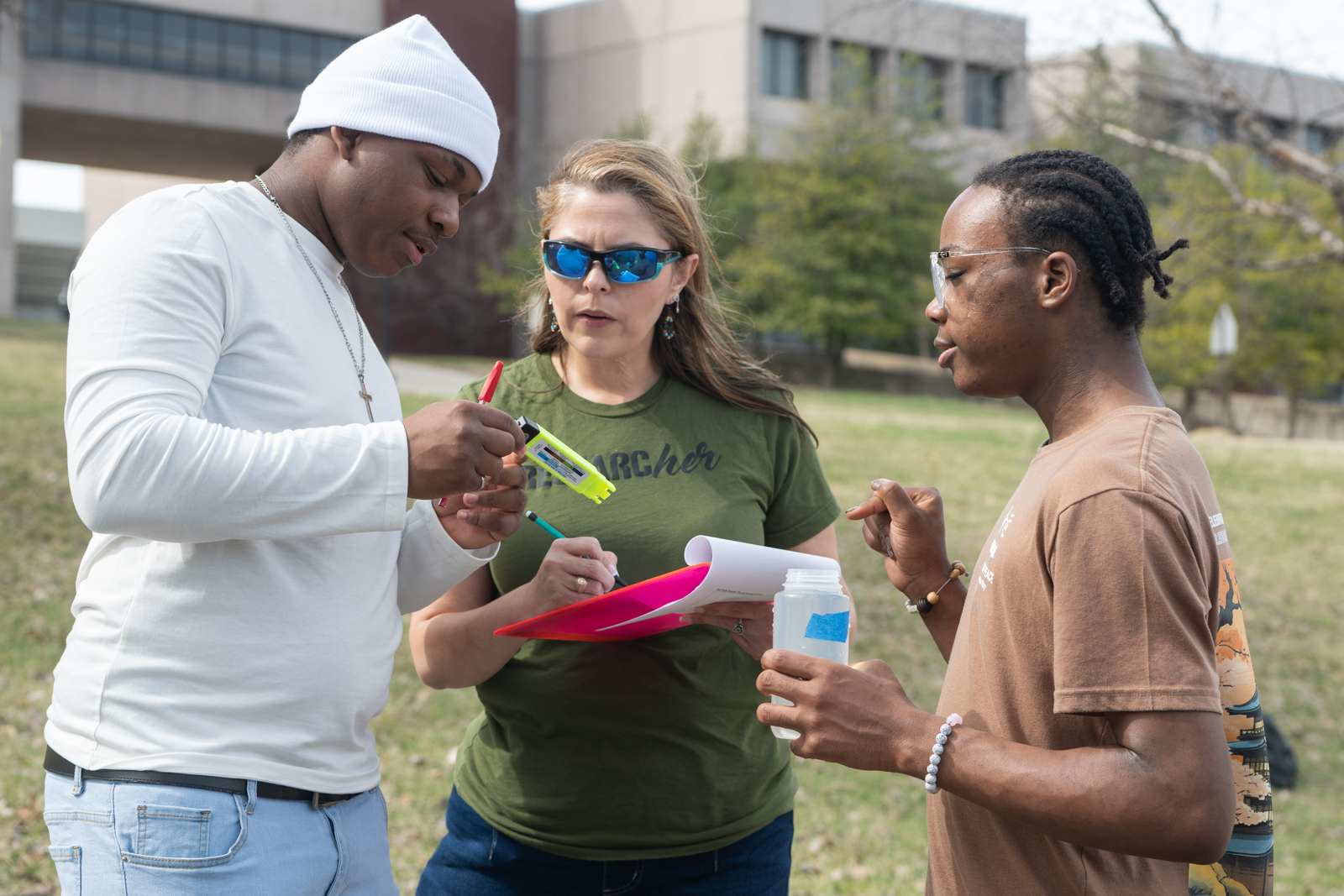
In spring 2025, students began conducting research within five distinct working groups: Water Fair, Young Adult Involvement in Conservation, Flooding Resources for Cahokia Heights, Biodiversity at JJK FAN, and Community Outreach. During this semester, the students learned how to conduct many different types of research. They developed and deployed surveys using Qualtrics. They also learned how to develop and conduct interviews. Some students also learned how to conduct archival research and digitization at SIUE’s Lovejoy Library and the Cahokia Public Library District, while others took scientific measurements at Cougar Lake to learn about measuring water quality parameters and conducting soil core collection and analysis. Throughout this semester, each group tailored their research to better their understanding of their specific project idea in the local context.
Semester 3: Implementation
In Fall 2026, students began developing their own materials, utilizing and expanding upon the research conducted during the previous semester. Some groups took ownership of a project that centered on a consistent goal from start to finish, while others groups took a non-linear path, experimenting with many different outputs before landing on the right one.
Restoring Water Equity in Cahokia Heights, Illinois
The project with one of the most linear paths was the Resources for Cahokia Heights website. Students began this project by collecting archival data and oral history interviews from current residents through their connections with the Cahokia Heights Library. Each student then conducted additional research in order to take ownership of a specific topic that they believed would be useful for residents of Cahokia Heights, including renter’s rights, locations of business who provide essential items, a history of flooding in the region, community organizations in the region, flooding FAQs, governmental organizations that provide assistance after natural disasters.
Empowering Changes Through Water Education
The Water Fair group also took a more linear path toward designing and implementing their project. Collectively, this group analyzed dozens of water activities for K-12 students, utilizing resources from the SIUE STEM Center and other educational databases. Four of the group members identified one lesson each they were interested in implementing as part of a Water Fair at JJK FAN’s after school program, another group member elected to interview other local community organizations to determine what sort of K-12 activities they conducted for comparison purposes, and the final group member developed a water lesson database of teacher resources.
Urban Greenscapes in Urban Landscapes
Also working with JJK FAN was a group of students who began by analyzing biodiversity and peoples’ relationships to nature in East St. Louis. They initially distributed a survey to East St. Louis residents to probe how and why they spend (or do not spend) time in local green spaces. Because of the low response rate received, the students then conducted an ethnography of two different parks in East St. Louis to see how people interacted with the environment in real time. While they had initially planned on conducting a local tree inventory as well—and some students eventually did do this as part of a side-project with Heartlands Conservancy—it soon became apparent that JJK FAN needed a group of students to research how to attract visitors to a new section of their campus being developed into a recreational green space. Therefore, some students in this group conducted research on the local flora, fauna, and ecology of the area, culminating in a design report; while other students focused on creating educational materials for JJK FAN to include on-site for visitor engagement.
Tree Equity
The Community Outreach group also began their project with a survey, designed in collaboration with Heartlands Conservancy, to learn about the perspectives of local stakeholders invested in environmental stewardship. Because of low survey response rates, however, this group instead decided to work on a new project that focused on Tree Equity in East St. Louis. As part of this initiative, students worked with a few members of the Northern Campus Redesign group to conduct a tree inventory, and independently conducted archival research to better understand the history of tree allocation in East St. Louis. This research informed a set of fliers they designed for a community workshop in East St. Louis, whose purpose was to inform and persuade residents of how planting trees can positively impact water quality and reduce flooding.
Educating Young Adults on Water Conservation
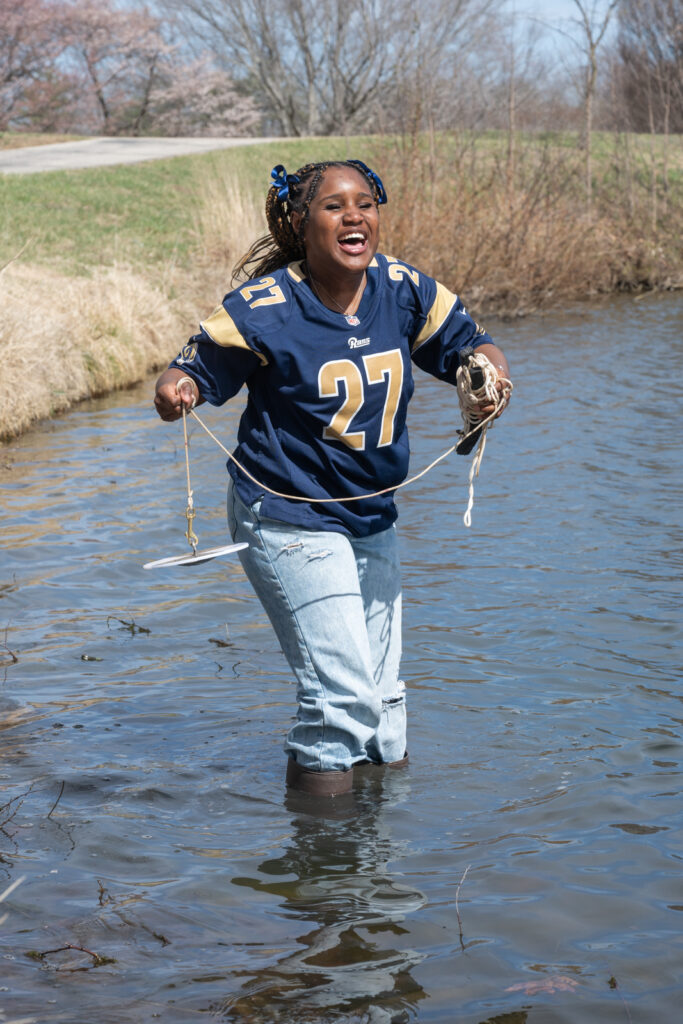
Heartlands Conservancy expressed a strong interest in recruiting a greater number of volunteers between the ages of 18 and 26; therefore, the Young Adult Involvement in Conservation group decided to focus their work on developing ways to attract this demographic to volunteer. Different group members approached this goal from a variety of lenses: some students conducted surveys and interviews of 18-26 year olds to determine motivations behind volunteering for organizations like Heartlands Conservancy, while other students collected video recordings of Heartlands Conservancy’s volunteer events and recorded information about activities they were hosting. This group used their data to create materials that appeal to an audience of 18-26 year olds, including X, Y, and Z. This culminated in the planning of an event…
